K. Budrys: The Nordic and Baltic Countries—A Model for Support for Ukraine and an Approach to Defense
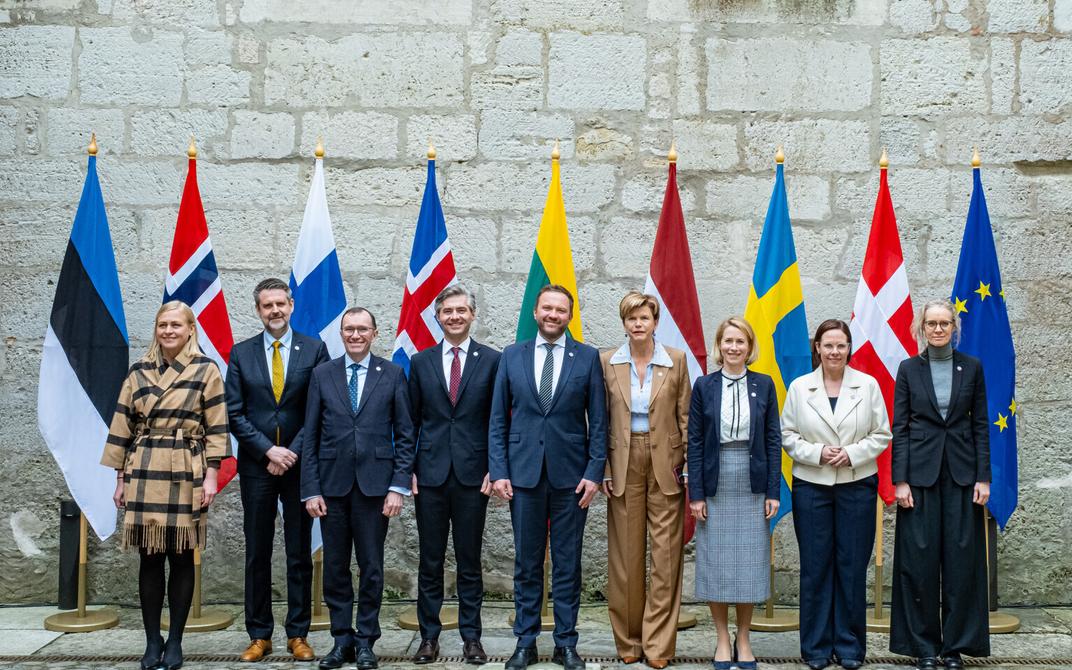 Estonia hosted a two-day visit for the NB8 Nordic and Baltic Foreign ministers at Kuressaare in Saaremaa on April 29-30, 2026.Source: Ministry of Foreign Affairs
On April 29–30, in Kuressaare, Estonia, Foreign Minister Kęstutis Budrys participated in the meeting of foreign ministers of the Nordic and Baltic Eight (NB8). The ministers discussed European security and defense issues, Russia’s aggression against Ukraine and support for Ukraine, transatlantic relations and NATO cooperation, and the situation in the Middle East.
Minister K. Budrys noted that Ukraine, which is defending itself against Russian aggression, is rapidly becoming a global security hub, and therefore Europe—especially the NB8 countries—must respond decisively to this transformation and help Ukraine integrate into the European Union by 2030 at the latest, as any delay runs counter to Europe’s own security interests.
“Our primary focus must continue to be providing assistance to Ukraine. Unfortunately, we are facing challenges due to varying levels of commitment among member states and reluctance to open the European Union to Ukraine’s full membership. We must clearly understand that if we fail to fill these critical gaps in support, it would have extremely negative consequences for European security. The Nordic and Baltic countries understand this very well; they are among the leaders in providing support to Ukraine. However, our efforts alone are not enough—it is essential to involve other countries as well, in order to achieve a more equitable burden-sharing and greater political support for Ukraine,” emphasized the Lithuanian Minister of Foreign Affairs.
Minister K. Budrys stressed that it is essential to preserve the unity of NATO allies, and that only a strong Europe can be considered a reliable ally of the United States and make the Alliance stronger, fairer, and more capable.
The Minister of Foreign Affairs expressed his satisfaction that, with Finland and Sweden’s accession to NATO, the entire Nordic and Baltic region has become a common security space, and the NB8 countries have become allies providing each other with security guarantees under NATO Article 5. At the same time, K. Budrys noted that maintaining a permanent U.S. presence in Europe and the deployment of other NATO allies’ forces in our region remains of vital importance.
“The United States of America is calling on Europe to take greater responsibility for strengthening its own security. The Nordic and Baltic countries are showing leadership within NATO by ambitiously increasing their defense spending, but all allies must move in the same direction. It is not our statements that matter, but the capabilities we possess,” emphasized K. Budrys.
Minister K. Budrys stressed the need to seek sustainable and long-term diplomatic solutions in the Middle East and to actively contribute to strengthening a rule-based international order.
“We support efforts to restore safe navigation in the Strait of Hormuz as soon as possible and to reaffirm freedom of navigation as one of the fundamental principles of international law,” said K. Budrys.
The meeting was also attended by Kaja Kallas, Vice President of the European Commission and the EU’s High Representative for Foreign Affairs and Security Policy.
The ministers adopted a joint statement. The text of the statement is available here.
The Nordic-Baltic Eight (NB8) is an informal and non-institutionalized cooperation format comprising five Nordic and three Baltic countries—Denmark, Estonia, Iceland, Latvia, Lithuania, Norway, Finland, and Sweden. The NB8 countries coordinate the group’s activities and agenda on a rotating basis each year and organize and host the meetings to be held that year. In 2026, Estonia is coordinating NB8 cooperation.
Photos courtesy of the Estonian Ministry of Foreign Affairs